
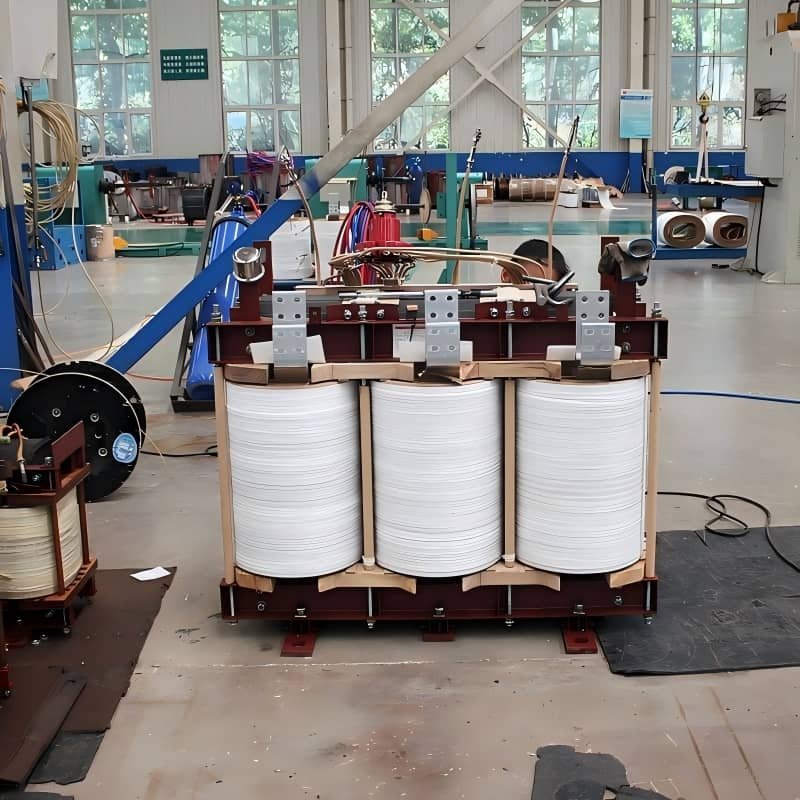

Delta y transformer connection/QIANLAI ELECTRIC
In a three-phase transformer, there are two connection methods for the three primary windings to be connected to a three-phase AC power supply, namely wye connection and delta connection, as shown in Figures (a) and (b) below.
For a wye (Y) connection, when the start terminals 1U1, 1V1 and 1W1 are used as the outgoing terminals, the three end terminals 1U2, 1V2 and 1W2 are connected together to form a neutral point. If the neutral point needs to be led out, it shall be marked with the symbol “N”, and the connection mode is denoted as YN. Similarly, the three secondary winding can also adopt these two connection methods.
Both the primary and secondary windings of a three-phase transformer can be configured in wye or delta connection. For the wye connection, the neutral point can either be led out or not. Thus, the primary and secondary windings can have the following connection combinations: Y/Y or Y/Yn; Y/Δ or Yn/Δ; Δ/Y or Δ/Yn; Δ/Δ, etc.
However, these combination symbols are not sufficient to fully describe all the connection relationships between the primary and secondary windings. It is also necessary to further use the clock vector method to illustrate the phase relationship of the electromotive force (EMF) between the primary and secondary windings.
A clock face has two hands and twelve numerals, which divide the dial into twelve divisions. Each division represents one hour. Since a full circle corresponds to 360°, each division equals 30°. The angle is calculated in the clockwise direction of the hour hand. For example, the angle between the 12 o’clock position and the 11 o’clock position is 30° × 11 = 330°. Conversely, if the hour hand rotates 300° clockwise, it must point to the 10 o’clock position (300° ÷ 30° = 10).
The connection group of a transformer uses this clock representation method to specify the phase relationship between the line voltages of the primary and secondary windings.
For a three-phase transformer, a certain phase difference exists between the line voltages of the primary and secondary windings due to different connection methods.
Take the primary line voltage as the minute hand and fix it at the 12 o’clock position, while taking the corresponding secondary line voltage phasor as the hour hand. If there is a phase difference of 330° between them, the secondary line voltage phasor must point to the 11 o’clock position (330° ÷ 30° = 11), as shown in the figure on the right. If the phase difference is 180°, the secondary voltage phasor will definitely point to the 6 o’clock position, which means the connection group of this three-phase transformer belongs to the 6 o’clock group.
Y/Y Connection
As shown in the figure below, both the primary and secondary windings adopt Y connection, and the homopolar terminals of the primary and secondary windings are taken as the start terminals. Therefore, it can be seen from the phasor diagram that the electromotive forces (EMFs) of the primary and secondary windings are in-phase, and thus the connection should be marked as “12”, namely the Y/Y-12 connection group.
The new standard denotes this connection as (y, y0). In Figure (b), the polarities of the primary and secondary windings are different. Thus, it can be observed from the phasor diagram that there is a 180° phase difference between the primary and secondary windings, so the connection is marked as “6”, which is called the Y/Y-6 connection group (denoted as y, y6 in the new standard).
Y/Δ Connection
In Figure (a) below, the primary winding is configured in Y connection while the secondary winding is configured in Δ connection. The homopolar terminals of both the primary and secondary windings are used as the start terminals. This connection method is designated as the Y/Δ-11 connection group (new standard: y, d11).